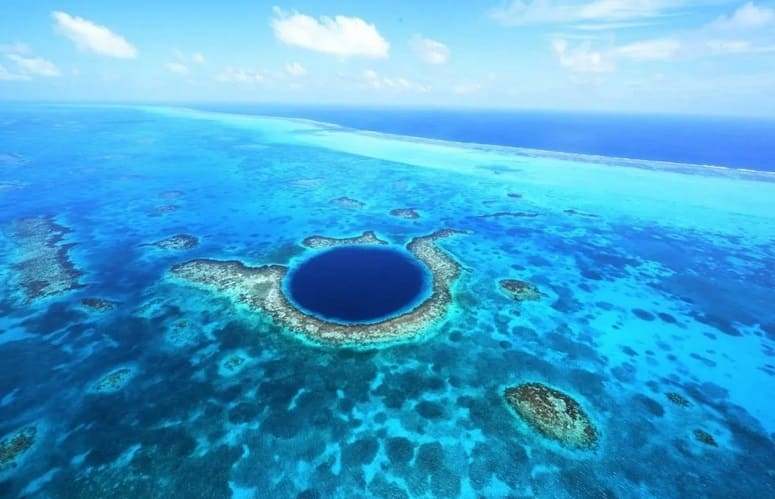

In 2023, Taam Ja’ Blue Hole, a giant hole hidden in a bay of the Yucatan Peninsula on the border with Belize was officially discovered by scientists based on ultrasound data and declared the world’s second largest blue hole. But, a little later, experts said they were not completely sure about their findings and what it really is. Let me tell you, this is a mysterious place where there are many myths and theories about aliens and the lost Atlantis civilization.
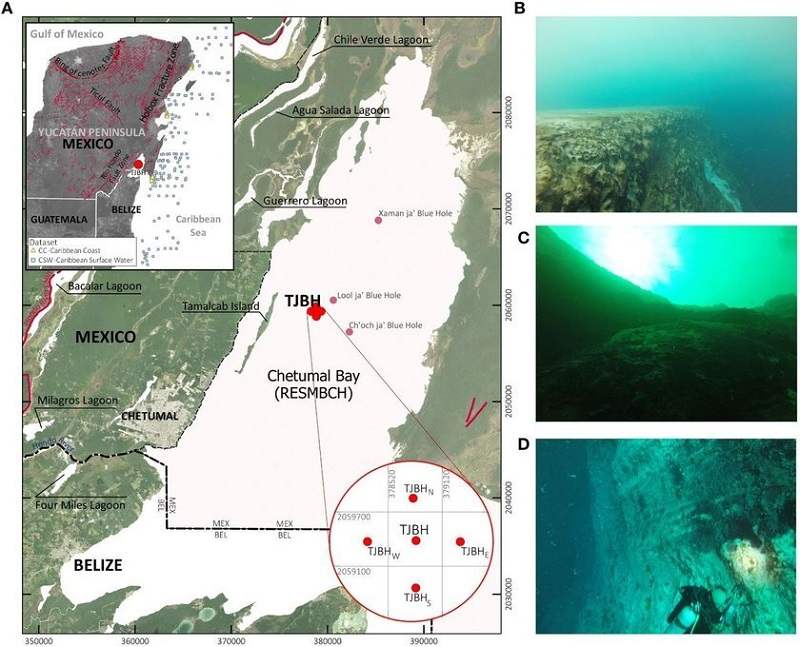
Viewed from above, the 150-meter-wide Taam Ja’ Blue Hole off the southeastern coast of Mexico resembles an iris-rimmed pupil around the blue sea floor.
The hole is so deep that even sound normally emitted in water cannot hit the bottom. Taam Ja’ absorbs the echoes of high-frequency acoustic waves before they reach a depth of more than almost 275 meters. One reason for this may be the presence of pycnoclines (sharp boundaries created by water of different densities that scatter acoustic signals).
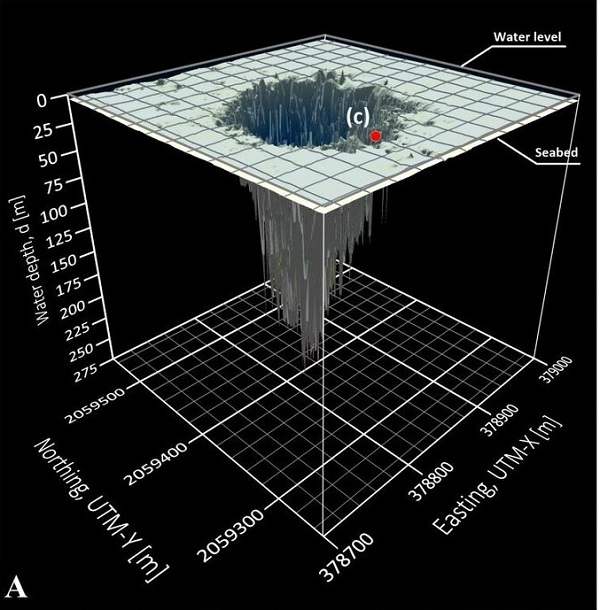
To find out how far the dark hole extends, scientists from the State Research Centre of the Universidad de La Frontera in Mexico docked a ship in the centre of this “eye” in December 2023 and lowered a cable; when all 500 meters of cable were deployed, the device had not yet reached the bottom!
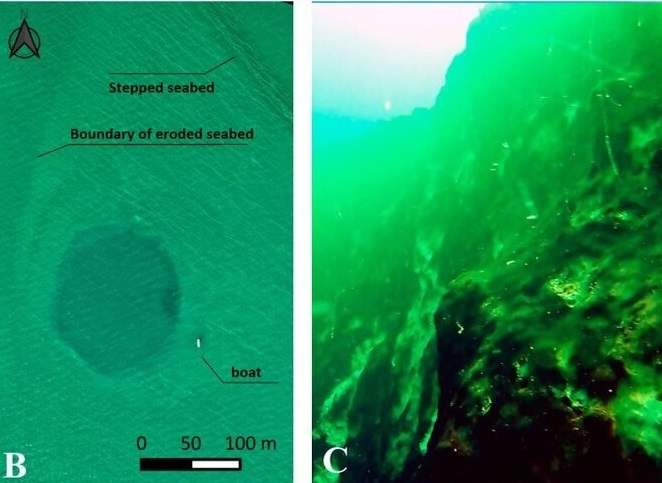
The device sank 420 meters below the sea surface because the limestone and gypsum walls of the Taam Jha Blue Hole do not slope straight down but at a slight angle.
Researchers found that the bottom has not yet been reached, but next time, underwater robots will be able to lower equipment to even greater depths, and experts will try to “reach the bottom” again.
There is a cluster of sinkholes around the Chicxulub crater, and while scientists don’t yet know what caused them, they suspect that the impact that killed the dinosaurs and many other animals may have influenced the strange geology of the region today.
A once extinct creature laid the foundation for an entirely new biological niche. Despite the dark, low-oxygen environment, the cenote is home to a thriving ecosystem. The same can be said for neighboring Tamu Daza.
Biologists continue to explore blue holes around the world to better understand their communities, and in some cases, encounter entirely new forms of life.
“The depth of the blue hole at Tamu Daza may create a unique biotope with biodiversity that needs to be studied in combination with physical and geomorphological processes,” researchers say.
And an expert team is ready to dive in. Let’s see what the world finds and what is hidden.

About the Author
Manish love to write and he is a Civil Servant. Users can follow Manish on Instagram 

Which are the most dangerous animals that Americans are scared of ?
In America, seemingly ordinary animals are responsible for the deaths of Americans every year for…

Vijay Mallya’s downfall: From the Deepika-Katrina calendar to the CBI affair !
Vijay Mallya, once known as the “King of Good Times,” is one of India’s most…

The Warmth and Beauty of Jaipuri Quilt (Jaipuri Rajai) in Winter Days
Welcome to the Pink City of Jaipur, where winter brings the pink chill and the…

Why do we say “Hello” when answering a phone ?
Have you ever questioned why “hello” is the default greeting upon picking up the phone?…

How Big Businesses or brands playing mind games to Buy Something
Have you ever thought How big businesses earn so much money when there are many…

Who is Shubhangi Atre ?
Indian television actor Shubhangi Atre is famous for her roles in Hindi TV series. She…


