
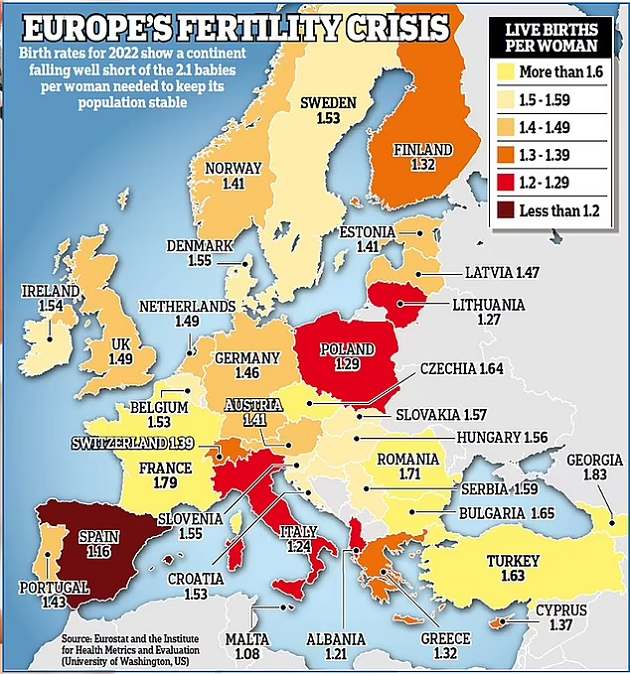
Europe is witnessing a sharp decline in fertility rates, reaching 1.08 children per woman in some countries such as Malta. This worrying trend has given rise to debate on the causes and possible solutions: does Europe’s future depend on immigration? Will immigrants from countries such as India, China, Pakistan and others take over the country in the future?
Cost of living is the best contraceptive here
One of the most commonly cited reasons for the decline in birth rates in Europe today is the “rising cost of living,” which has made raising a family a major challenge for young people, compounded by the migration problem.

High housing prices and rents in Europe today make it very difficult for families to expand their population. For example, a friend of mine told me that upgrading from a three-bedroom house to a four-bedroom house in London will cost an additional £150,000 on average.
This is a difference many people cannot afford without it reducing their quality of life. In addition, the cost of childcare in cities like London is very expensive, even for urbanites earning above-average wages. This “financial stress” forces many couples to delay or reconsider having children. So looking at Europe, I think “cost of living is the best contraceptive” here.
Doing less burden on Earth ?
While India and China are still agrarian societies, Europe has evolved from an industrial society to a modern society where bodily rights, women’s freedom, and rational thinking have broken the shackles. It makes sense that Europe has less crime and more freedom than other developing countries, and people are happier than people in the third world.

Still, modern social values play a role as well. People in Europe are motivated to prolong their “young-adult” lifespan, focus on careers, and enjoy personal freedom, and why not?
Europe is so developed. Starting a family is often becoming a priority among the young, and corporate companies view employees with young children as less productive, further reducing their interest in becoming parents.
Additionally, awareness of overpopulation and environmental concerns has led some to believe that having fewer children is better for the planet as a whole, and rightly so.
Some others argue that feminist movements and liberal social norms have inadvertently weakened the traditional family structure, promoting a sense of individualism that makes long-term relationships and parenting less attractive, but this is a result of conservative male thinking.
Then vs Now
Critics argue that modern challenges pale in comparison to those of the past. There was a time when families raised many children in cramped homes with few resources.
Expectations have changed considerably, however. Today, families desire spacious homes and amenities such as separate bedrooms and multiple bathrooms for each child—luxuries that were unimaginable 50 years ago.
Economic policies also compound the problem. For example, changes in lending practices—allowing people to borrow up to nine times their salary—have fueled a rise in housing prices, making home ownership increasingly unattainable for young families.
Immigration and Fertility Rates
Some argue that Europe should focus on policies that encourage native-born Europeans to have more children, rather than relying on immigration to maintain population numbers. However, this is not a quick fix.
Immigrants also face the same economic pressures—high housing costs, expensive childcare, and stagnant salaries. Over time, they too may stop having more children.
The problem is not that Europe is on the right track for rationality and international morality, but that countries like India and China are lagging far behind in this direction.

Amazing: Before and After pics
Analysing images taken before and after an event is an interesting experience, particularly when the…

8 STEPHEN HAWKING – THE SCARY PREDICTIONS
Stephen hawking was one of the most powerful and brilliant minds of our time, to the point…

How can we stay happy and healthy forever
“How we can be happy” is a main goal in every of every person or…

Have you ever been to Jibhi?
If you are looking for a “value for money” destination where you get abundant natural…

What would have happened if Hitler had not started World War II?
Hitler is one of the most important figures in human history, causing World War II…

Korean Women’s Secrets to Maintaining a Fit and Healthy Lifestyle
Korean women are recognised for their slim and balanced bodies and bright complexions. Many people…


